How many years should shock absorbers last?
We often take a smooth ride for granted, but the components responsible for it work harder than almost any other part of the vehicle. Drivers frequently ask how long they can expect this comfort to last before a repair bill arrives.
Shock absorbers typically last between 5 and 7 years, or approximately 50,000 to 80,000 miles (80,000 to 130,000 km). However, this lifespan varies significantly based on driving conditions; vehicles driven on rough, unpaved roads or used for heavy towing may need replacements as early as 40,000 miles.
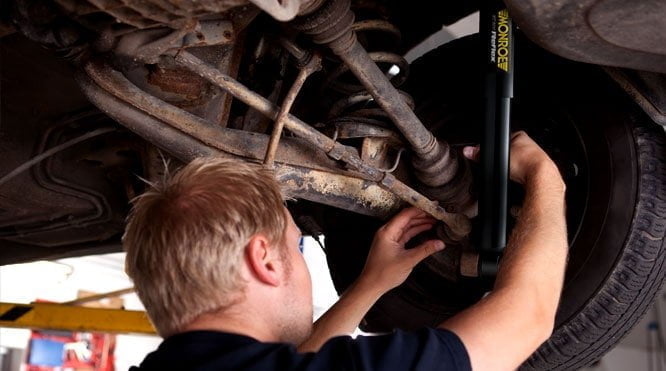
While they might not physically break at this mileage, their internal performance degrades. The oil inside breaks down due to heat, and the gas pressure drops. We recommend a "50,000-mile checkup" because worn shocks increase stopping distances, compromising safety long before they completely fail.
How many shock absorbers are in a car?
When ordering parts, it is crucial to know exactly what the vehicle requires.
Most standard passenger vehicles have four shock absorbers—one for each wheel. In many modern cars, the front suspension uses "Strut Assemblies" (which combine a shock and a spring holder), while the rear uses standard shock absorbers. Regardless of the name, there is always one dampening unit per corner.
The Importance of replacing in pairs
You should never replace just one shock absorber. If one rear shock fails, the other is likely just as worn. Replacing only one creates an imbalance—one side of the car will be stiff and responsive, while the other is soft and bouncy. This can cause dangerous handling during emergency maneuvers. At GSW Autoparts, we always advise distributors to sell shocks in axle pairs (Front Pair or Rear Pair) to ensure customer safety.
Can you repair shock absorbers?
In an era of rebuilding and recycling, customers often ask if they can fix a leaking shock instead of buying a new one.
No, standard automotive shock absorbers cannot be repaired. They are manufactured as sealed, pressurized units. Attempting to open them is dangerous due to the high-pressure gas inside. Once the internal seals fail or the fluid leaks out, the entire unit must be replaced.
Why they are "One-Time Use"
Standard road car shocks are crimped shut at the factory. There are no screws to open them. The internal components—valves, pistons, and seals—are precision-matched.
Safety Risk: Many shocks contain nitrogen gas under high pressure. Drilling or cutting into one can cause it to explode.
Economic Reality: Even if they could be opened, the labor cost to rebuild them would exceed the price of a brand-new GSW Autoparts replacement shock, which comes with a fresh factory warranty.
What are 5 signs and symptoms of bad shock absorbers?
How does the car "tell" you that the suspension is dead? Identifying these five physical symptoms can prevent accidents.
1. Increased Stopping Distance Worn shocks allow the car's weight to shift forward aggressively when you brake. This "nose dive" reduces rear tire grip and can increase stopping distance by up to 20%.
2. Excessive Bouncing The classic "Bounce Test." If you hit a bump and the car bounces more than once or twice, the dampers are dead. They are no longer controlling the spring energy.
3. Body Roll and Sway If the car feels like a boat in a storm when you turn a corner, or if it gets pushed sideways easily by crosswinds on the highway, the shocks are too weak to keep the body stable.
4. Uneven Tire Wear (Cupping) This is a definitive physical sign. As the tire bounces uncontrollably on the road, it gouges out patches of rubber. This leaves a wavy, scalloped pattern on the tire tread known as "cupping."
5. Fluid Leaks A visual check is powerful. If you see fresh oil coating the body of the shock absorber, the internal seal has blown. An oily shock is a failed shock.
What are the first signs of bad shocks?
You don't want to wait until the car is bouncing uncontrollably. Detecting the early signs saves money on tires and other suspension parts.
The very first sign of bad shocks is often subtle: a "floaty" sensation at highway speeds or slight nose-diving during gentle braking. You may also notice a clunking noise when driving over small chatter bumps or railroad tracks.
Before the leaks appear, you will feel the weight transfer. Pay attention when you come to a stop sign. If the hood of the car dips down noticeably and then bobs back up, your front struts are beginning to fail. Catching it at this stage protects your control arm bushings and ball joints from taking extra abuse.
Conclusion
Shock absorbers are vital for keeping your tires on the road, typically lasting 5 to 7 years. Because they cannot be repaired, recognizing the early signs of failure—like nose-diving and tire cupping—is the best way to maintain vehicle safety. We provide precision-engineered replacement shocks that restore factory control and comfort.